Alexander Calder and the Kinetic Revolution A Century of Innovation at the Fondation Louis Vuitton

The artistic landscape of the 20th century was fundamentally reshaped by the arrival of an American engineer-turned-artist in Paris in 1926, a milestone now being commemorated by the Fondation Louis Vuitton in a landmark retrospective. Alexander Calder, whose name has become synonymous with the invention of the mobile, is the subject of a comprehensive exhibition that tracks his evolution from a figurative wire sculptor to the master of monumental abstraction. Running through August 16, the exhibition serves as a critical examination of how Calder’s century-old arrival in the "City of Light" ignited a creative spark that would eventually liberate sculpture from its traditional pedestal, introducing the elements of motion, transparency, and chance into the canon of modern art.
The presentation at the Fondation Louis Vuitton is not merely a collection of aesthetic objects but a scholarly assembly of sculptures, drawings, jewelry, and archival materials that illustrate the intersection of mechanical precision and lyrical abstraction. By bringing together rare works from the Calder Foundation in New York and various international institutions, the exhibition provides a rigorous look at an artist who successfully bridged the gap between the industrial grit of American engineering and the avant-garde experimentation of the Parisian art scene.

The Parisian Catalyst: A Chronology of Transformation
Alexander Calder’s journey to becoming a titan of modernism began far from the galleries of Europe. Born in 1898 into a family of traditional sculptors—his father and grandfather both being renowned for their classical monuments—Calder initially sought a different path, earning a degree in mechanical engineering from the Stevens Institute of Technology in 1919. This technical foundation would later prove indispensable, providing him with the mathematical and structural knowledge required to balance tons of steel on a single point of contact.
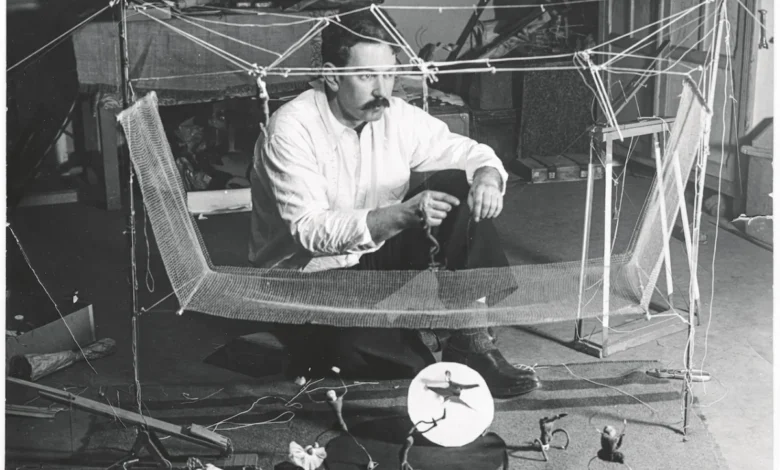
However, the allure of the creative life persisted. After a brief stint as an illustrator for the Police Gazette and studies at the Art Students League in New York, Calder set sail for Paris in 1926. This move marked the beginning of a transformative period. Upon his arrival, he settled in the vibrant Montparnasse district, which was then the epicenter of global modernism. It was here that he developed Cirque Calder (1926–1931), a complex, miniature circus made of wire, wood, and cloth. This work, featured prominently in the current exhibition’s historical context, was more than a toy; it was a performance piece that introduced Calder to the leading figures of the Parisian avant-garde, including Joan Miró, Fernand Léger, and Marcel Duchamp.
The turning point in Calder’s career occurred in 1930 during a visit to Piet Mondrian’s studio. Observing the stark, geometric arrangements of color on Mondrian’s walls, Calder suggested that these forms should "oscillate." While Mondrian disagreed, the encounter prompted Calder to abandon figurative wire work in favor of pure abstraction. Shortly thereafter, he began creating kinetic works. In 1931, Marcel Duchamp dubbed these moving sculptures "mobiles," a term that played on the French words for both "motion" and "motive." Conversely, Jean Arp later suggested the term "stabiles" for Calder’s stationary works, highlighting the duality of his practice.

Engineering the Ethereal: Supporting Data and Technical Mastery
Calder’s contribution to art history is often measured by his ability to make heavy materials appear weightless. The Fondation Louis Vuitton exhibition highlights the technical rigor behind this illusion. Unlike traditional sculpture, which occupies space through mass and volume, Calder’s mobiles occupy space through "drawing in the air."
Statistical analysis of his mid-career works reveals a sophisticated understanding of center-of-gravity physics. His mobiles are constructed using a system of levers and counterweights, where each arm of the sculpture is balanced independently. This allows the entire structure to respond to the slightest air currents, creating a composition that is never the same twice. The exhibition includes archival sketches that demonstrate Calder’s meticulous planning, showing how he calculated the proportions of his sheet-metal "leaves" to ensure they would not collide while in motion.
Beyond the mobiles, the exhibition showcases Calder’s "stabiles"—monumental works often made of bolted steel plates. In the 1950s and 60s, Calder’s output shifted toward these large-scale public commissions. Data from the Calder Foundation indicates that during this period, he collaborated with industrial ironworks, such as the Biémont foundry in Tours, France, to realize structures that reached heights of over 60 feet. These works, such as the iconic Flamingo in Chicago or La Grande Vitesse in Grand Rapids, redefined the relationship between public art and urban architecture, proving that abstraction could function on a civic scale.

Curatorial Vision and Official Perspectives
The curation of the current exhibition at the Fondation Louis Vuitton aims to present Calder as a multidisciplinary innovator. By including his jewelry and gouaches alongside his sculptures, the organizers emphasize that Calder’s vision was holistic. His jewelry, often hammered from brass or silver wire, mirrors the linear quality of his large-scale sculptures but on an intimate, wearable scale.
Alexander S.C. Rower, the grandson of the artist and president of the Calder Foundation, has frequently noted that Calder did not view his work as "static objects to be looked at," but as "performative entities." This sentiment is echoed in the exhibition’s layout, which utilizes the Frank Gehry-designed galleries to provide ample space for the works to breathe and move. The interaction between the shifting natural light of the Fondation and the kinetic surfaces of the mobiles creates a dynamic viewing experience that aligns with Calder’s original intentions.
"Calder was an artist of the ‘now,’" curatorially speaking, the exhibition argues. By removing the glass cases typically associated with historical retrospectives where possible, the Fondation allows the viewer to experience the displacement of air and the subtle vibrations of the wire, reclaiming the visceral impact that Calder’s work had on his contemporaries in the 1930s.

Broader Impact and Implications for Contemporary Art
The implications of Calder’s work extend far beyond the mid-century modern era. He is widely credited with being the father of kinetic art, a movement that challenged the idea of the "finished" or "fixed" artwork. His influence can be seen in the works of contemporary artists such as Olafur Eliasson, whose installations often deal with light and movement, and Richard Serra, who, while working in a much heavier register, shares Calder’s preoccupation with the physical experience of space.
Furthermore, Calder’s success as an American in Paris established a template for the internationalism that defines the modern art market. He was one of the first American artists to achieve true global fame during his lifetime, proving that American ingenuity could compete with and enhance the European tradition. The current exhibition serves as a reminder of this cultural exchange, occurring at a time when the art world is increasingly focused on the intersections of technology and manual craft.
The enduring popularity of Calder’s work—reflected in the consistently high attendance at the Fondation Louis Vuitton—is a testament to the universal appeal of balance and motion. In an era dominated by digital screens and static images, the physical reality of a Calder mobile offers a rare moment of contemplative presence.

Conclusion: A Legacy in Flux
As the exhibition concludes its run on August 16, it leaves behind a reinforced understanding of Alexander Calder not just as a creator of "whimsical" objects, but as a serious intellectual who redefined the physics of beauty. The 100th anniversary of his arrival in Paris serves as more than a historical footnote; it marks the moment when sculpture was set free from the earth.
Through his mastery of wire, sheet metal, and the invisible forces of the atmosphere, Calder created a body of work that remains eternally modern. The Fondation Louis Vuitton’s tribute successfully captures this spirit of perpetual motion, ensuring that a century after he first stepped onto the streets of Paris, Calder’s vision continues to circulate, oscillate, and inspire. The exhibition stands as a definitive record of an artist who understood that in life, as in art, balance is not a static state, but a continuous act of adjustment.