
President Trump’s Warning on D.C. Crime Numbers Vindicated as Police Department Faces Scandal Over Alleged Data Manipulation

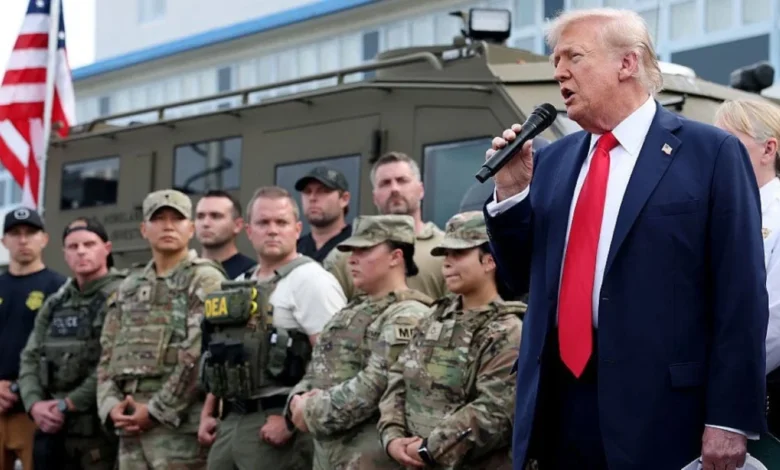
Nearly a year after President Donald Trump voiced concerns that the District of Columbia might be presenting inaccurate crime statistics, leading to his controversial deployment of the National Guard to the nation’s capital, the Metropolitan Police Department (MPD) is now embroiled in a significant scandal. An ongoing internal investigation has revealed alleged manipulation of crime reporting, resulting in 13 officers being placed on administrative leave, with some facing termination. This development has brought renewed scrutiny to the president’s earlier assertions and ignited a firestorm of political fallout.
The investigation, spearheaded by the MPD’s Internal Affairs Bureau, was reportedly referred to the department earlier this year by the U.S. Attorney’s Office. Interim Chief Jeffrey Carroll confirmed the investigation’s completion and the subsequent actions taken against officers, including senior officials such as an assistant chief and a district commander, who are reportedly under scrutiny. The MPD has not immediately responded to requests for further comment on the specifics of the alleged misconduct.
A Pattern of Suspicion: Trump’s Initial Accusations
President Trump’s deployment of the National Guard in August of the previous year was met with widespread criticism from District officials and Democratic lawmakers. At the time, Trump took to his Truth Social platform to declare that "DC gave fake crime numbers in order to create a false illusion of safety." He asserted that Washington D.C. was, in his view, the "least safe city in the U.S. and perhaps the world" prior to the National Guard’s arrival. His remarks, coupled with the federal intervention, were decried by many as an overreach and an insult to the city’s autonomy.
Del. Eleanor Holmes Norton, D-D.C., a non-voting representative for the District, vehemently opposed the president’s actions, labeling the use of federal law enforcement within her city as a "disproportionate overreaction" and "offensive." Similarly, D.C. Attorney General Brian Schwalb launched a legal challenge against the federal government, suing over what he termed an "unlawful attempt to take over [MPD]" and the Justice Department’s invocation of the Home-Rule Act. Schwalb’s office maintained that Trump lacked the authority to supersede then-MPD Chief Pamela Smith, characterizing the move as a "hostile takeover" and a threat to the District’s self-governance.
Senator Charles Schumer, D-N.Y., then Senate Majority Leader, also voiced strong opposition, reportedly using profane language to dismiss the idea of Congress consenting to an extension of the National Guard’s presence. He suggested that Trump’s actions were an attempt to distract from other ongoing political controversies, including the unfolding Jeffrey Epstein case files.
The House Oversight Committee’s Role
Adding a significant layer to the unfolding narrative, House Oversight Committee Chairman James Comer, R-Ky., has claimed credit for the recent suspensions and potential terminations within the MPD. In a statement, Comer asserted that these actions are a "direct result of the Oversight Committee’s work exposing dangerous efforts by DC Police leaders to artificially lower crime rates." The committee’s investigation into the MPD’s crime reporting practices appears to have provided crucial information that contributed to the federal probe.
Details of the Alleged Misclassification
While the full scope of the investigation remains under wraps, preliminary reports suggest that thousands of crime cases may have been misclassified. This practice, if proven, could have systematically distorted the public perception of crime levels in the District, creating a false sense of security and potentially impacting policy decisions and resource allocation. The Daily Crime Report (DCR), a crucial tool for tracking and communicating crime statistics to the public, is reportedly at the center of the alleged falsification.
The Union’s Perspective: A Culture of Coercion and Corruption
The union representing MPD officers has welcomed the news of the investigation and subsequent actions, suggesting that it validates their long-held concerns about the department’s internal culture. Gregg Pemberton, the union boss, stated that members had "warned that this toxic culture of coercion, fear, and corruption left thousands of cases uninvestigated, denied victims justice, gaslit residents, and endangered public safety." He detailed a disturbing scenario where "forensic teams were not dispatched, evidence went uncollected, detectives were never notified, and dangerous criminals walked free. All while the public was fed falsified Daily Crime Report (DCR) numbers." This account paints a grim picture of systemic failures and deliberate obfuscation, prioritizing appearance over actual public safety.
Broader Implications and Potential Consequences
The revelations have far-reaching implications. Firstly, they call into question the reliability of crime statistics not only in Washington D.C. but potentially in other jurisdictions as well, prompting a broader re-examination of data collection and reporting standards across the nation. Secondly, the scandal could erode public trust in law enforcement, particularly in the nation’s capital, where the perception of safety is paramount.
The political ramifications are also significant. President Trump’s prescient warning, though initially dismissed and criticized, now appears to have been remarkably accurate. This vindication could bolster his standing among his supporters and fuel further debate about federal oversight of local law enforcement in critical areas. Conversely, it places the current District leadership in a precarious position, facing questions about their accountability and transparency.
The timing of this scandal, occurring in the lead-up to potential future elections, could also influence public discourse and voter sentiment regarding public safety and governance. The interagency cooperation between the U.S. Attorney’s Office, the MPD’s Internal Affairs Bureau, and the House Oversight Committee highlights a multi-pronged approach to addressing alleged misconduct within law enforcement.
A Timeline of Events
- [Approximately one year prior to the current date]: President Donald Trump publicly expresses skepticism about Washington D.C.’s crime reporting and deploys the National Guard to the nation’s capital. He alleges that the District is presenting "fake crime numbers" to create a "false illusion of safety."
- [During the National Guard deployment]: District officials, including Del. Eleanor Holmes Norton and D.C. Attorney General Brian Schwalb, vehemently criticize President Trump’s actions as an overreach and a violation of D.C.’s self-governance. AG Schwalb initiates legal action against the federal government. Senator Charles Schumer also expresses strong opposition.
- [Earlier this year]: The U.S. Attorney’s Office refers an investigation into alleged crime reporting manipulation within the Metropolitan Police Department to the MPD’s Internal Affairs Bureau.
- [Recent weeks/months]: The House Oversight Committee, under Chairman James Comer, conducts its own investigation into the MPD’s crime statistics, reportedly uncovering evidence of efforts to "artificially lower crime rates."
- [Present Day]: MPD Interim Chief Jeffrey Carroll announces that an investigation has been completed, leading to 13 officers being placed on administrative leave, with some facing termination. Senior officials are reportedly among those scrutinized. The MPD confirms the investigation was referred by the U.S. Attorney’s Office. The union representing MPD officers welcomes the developments, citing a "toxic culture of coercion, fear, and corruption."
Looking Ahead: Accountability and Reforms
The ongoing investigation promises to shed more light on the extent of the alleged data manipulation and the individuals responsible. The consequences could range from disciplinary actions and terminations to potential criminal charges, depending on the severity of the findings. Furthermore, this scandal is likely to spur calls for enhanced oversight mechanisms, independent audits of crime statistics, and potentially reforms within the MPD to prevent future occurrences.
The situation underscores the delicate balance between maintaining public order and ensuring the integrity of data that informs public policy and shapes public perception. As the investigation unfolds, the nation will be watching to see how accountability is enforced and what measures are implemented to restore confidence in the reporting of crime in the nation’s capital. The initial warning from President Trump, once a point of political contention, has now become a focal point of a significant law enforcement scandal, raising fundamental questions about transparency and trust in the justice system.


